
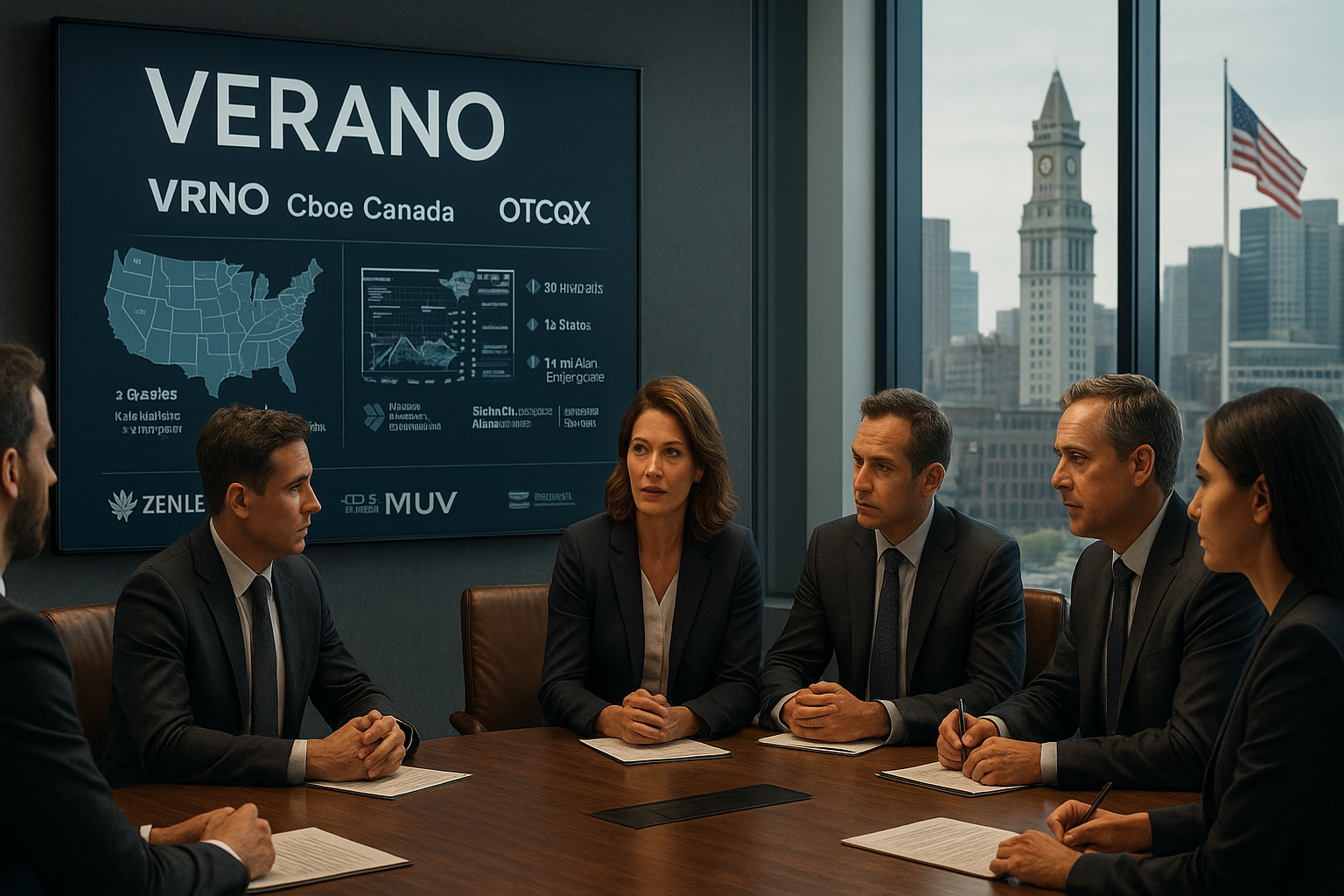
Verano Holdings Corp. will send members of its executive leadership team to the Canaccord Genuity 46th Annual Growth Conference in Boston on August 11, 2026, where the multi-state operator plans a fireside chat and a round of investor meetings starting at 10:30 a.m. ET. The company, which trades as VRNO on the Cboe Canada exchange and OTCQX, framed the appearance as a routine investor-relations touchpoint rather than a strategic announcement, but the timing still matters for anyone tracking capital flows into state-licensed cannabis operators.
Conference appearances like this one function as a proxy for how institutional money views the sector's health. Multi-state operators such as Verano operate under a patchwork of licensing regimes, tax structures, and banking restrictions that make cross-state comparisons genuinely difficult, so fireside chats give analysts a rare chance to ask direct questions about capital allocation, cultivation capacity, and retail performance across markets. Verano's footprint spans 13 states with 14 production facilities and more than 1.1 million square feet of cultivation space, a scale that requires tight coordination between wholesale pricing strategy, dispensary-level inventory management, and compliance reporting in each jurisdiction. Operators managing that kind of geographic spread increasingly lean on integrated retail software - the same category of tool that powers a Montana cannabis POS deployment for a single-state operator - to keep seed-to-sale tracking, tax calculations, and SKU-level reporting aligned across dozens of storefronts.
Why Investor Conferences Carry Weight for Cannabis Operators
Cannabis companies remain locked out of most federal financial infrastructure. No national exchange listing, limited access to traditional lending, and the continuing weight of Section 280E on tax liability all push multi-state operators toward alternative capital markets like Canaccord's growth conference circuit. For a company operating dispensaries under banners including Zen Leaf and MÜV, plus a portfolio of consumer product brands, these meetings are where institutional investors probe margin pressure, state-by-state regulatory risk, and whether vertical integration is actually paying off at the store level or just adding overhead.
What Operators and Suppliers Should Watch
Smaller operators and ancillary vendors - payment processors, packaging suppliers, compliance software firms - tend to watch what large multi-state operators say at these events for early signals on capital spending and expansion plans. A pullback in cultivation investment or a shift toward asset-light retail strategy from a company of Verano's size can ripple through wholesale menus and supplier contracts well before it shows up in quarterly filings.
- Multi-state operators face inconsistent excise tax and licensing rules across every market they enter
- 280E continues to inflate effective tax rates for plant-touching businesses regardless of state legality
- Investor conferences serve as informal checkpoints on cultivation capacity utilization and retail same-store performance
- Ancillary vendors, including POS and seed-to-sale software providers, track MSO commentary for signals on expansion or contraction
The Compliance Backdrop Investors Weigh
None of this happens in a vacuum. Every dispensary Verano operates must maintain compliant packaging, verified age-gating at point of sale, and lab-tested product batches with current certificates of analysis, all logged through state-mandated tracking systems like METRC. Investors asking questions at a fireside chat are, in effect, asking how well an operator manages that compliance burden at scale - because a single lapse in one state's licensing requirements can stall store openings or trigger penalties that dent quarterly results fast.