
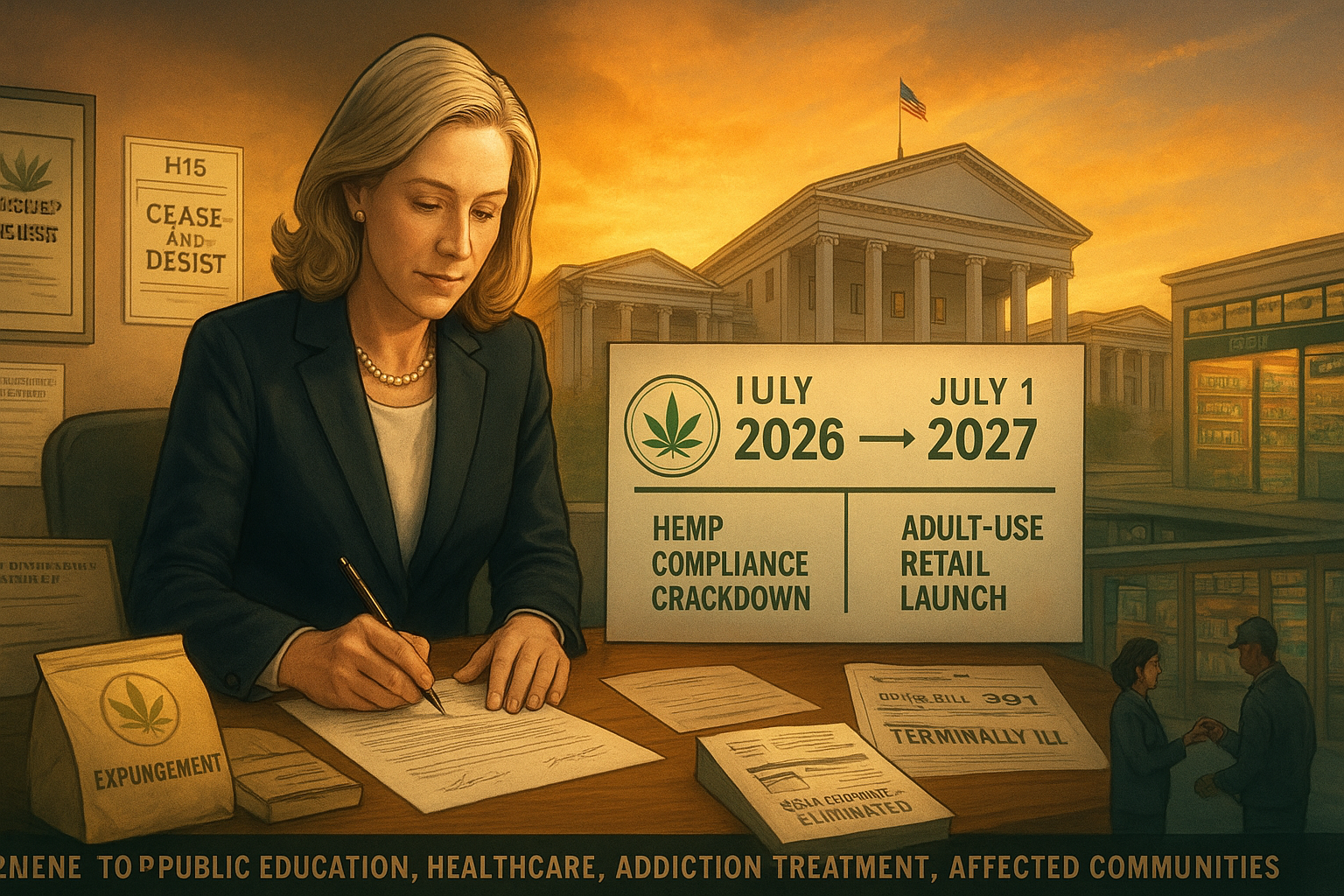
Virginia has locked in the regulatory framework for its adult-use cannabis retail market, with licensed dispensaries set to open July 1, 2027 - but the compliance calendar starts moving much sooner than that. Following a budget compromise between the General Assembly and Governor Abigail Spanberger, the Cannabis Control Authority (CCA) released a finalized timeline that includes significant enforcement changes beginning in August 2026, touching every corner of the supply chain, from hemp product sellers to licensed retailers to consumers browsing store shelves today.
The 2027 retail market carries real fiscal weight: future tax revenues are legally earmarked for public education, health care, addiction treatment, and communities disproportionately affected by past drug enforcement. For operators and investors tracking the broader mid-Atlantic region, that revenue-allocation structure signals a policy approach that mirrors models seen in other regulated states - for those building compliance and market-entry strategies across state lines, resources like learn more about adjacent market frameworks can offer useful context. The key takeaway for Virginia-focused operators is that the state has tied its cannabis program to visible public benefit, which tends to generate sustained political will to protect the licensed channel and aggressively shut down unlicensed competition.
The Hemp Crackdown That Changes the Shelf Immediately
Here's the part that hits retailers well before 2027. Effective August 2026, regulatory authority over all hemp-derived products transfers from Virginia's agriculture officials to the CCA. That jurisdictional shift alone would be significant - but what follows on August 15, 2026, is the more operationally disruptive move.
Virginia is eliminating the so-called 25:1 loophole, which previously permitted hemp products to exceed two milligrams of THC per package as long as they maintained a 25-to-1 CBD-to-THC ratio. Under the new standard, any product containing more than two milligrams of total THC per package cannot be legally produced or sold as a hemp product in the Commonwealth. Full stop.
In practice, that rewrites a meaningful portion of what many convenience stores, smoke shops, and unlicensed hemp retailers currently carry. Operators in those categories have a narrow window to audit their SKU mix, pull non-compliant products, and - if they want to remain in the hemp space - register with the CCA. The state has committed to communicating directly with existing hemp retailers about registration renewals, but waiting for that outreach is a risky posture given the enforcement powers now attached to non-compliance.
Enforcement Has Real Teeth This Time
Senate Bill 543 gives the CCA authority to issue immediate notices of violation, levy civil penalties, and issue cease-and-desist orders against unlicensed businesses. That's a notably broader and faster enforcement toolkit than many state cannabis authorities carry in the early stages of market development. The ability to act without a lengthy administrative proceeding dramatically shortens the window between observed violation and business disruption.
The state is also deploying a public reporting mechanism - residents can flag suspected illegal commercial activity online or by calling 1-844-WEED-TIP. That's a consumer-facing enforcement layer that effectively extends the CCA's reach into retail environments the agency can't physically monitor at scale. Licensed retailers, meanwhile, are required to display a state-issued compliance decal in their storefront windows - a low-tech but direct signal to consumers, landlords, and enforcement personnel about legal standing.
What's striking here is the sequencing. Virginia isn't waiting until dispensaries open in 2027 to begin clearing the market of unlicensed competition. The state is using the 2026 hemp transition as an enforcement ramp - creating a compliant, traceable commercial environment before adult-use retail launches. That's a structurally sound approach, and one that licensed operators should understand clearly: the legal playing field is being actively prepared in their favor, but only for businesses that get their compliance posture in order now.
Beyond Retail: Equity and Medical Access Provisions
The retail framework doesn't stand alone. Several companion bills address adjacent policy priorities that affect both market participants and the broader licensed industry's public legitimacy.
- House Bill 391 and House Bill 75 expand medical cannabis access for terminally ill patients.
- Senate Bill 230 and House Bill 26 create pathways to expunge certain past marijuana-related records and modify prior sentences.
- House Bill 942 protects parental rights around the legal use of authorized substances.
The expungement provisions matter to the licensed industry beyond the obvious social equity dimension. In states where expungement has moved in parallel with retail licensing, it has helped reduce the political friction that otherwise stalls regulated market development. For Virginia-based operators seeking social equity licensing considerations in the 2027 rollout, these legislative actions form part of the qualifying framework they'll need to track closely.
Governor Spanberger had vetoed an earlier cannabis retail bill in May, citing concerns over public health, youth safety, implementation costs, and program effectiveness. The finalized framework is the product of negotiations that addressed those objections sufficiently to move forward. That context matters: this is a market built on political compromise, which means the rules were written with scrutiny built in - and enforcement will likely be held to a higher public standard than in states where cannabis legalization passed with broader political consensus.
Licensing updates will be published by the CCA as they become available. For operators, compliance vendors, and technology providers positioning for Virginia's 2027 market, the time to begin is now - not the summer before opening day.