
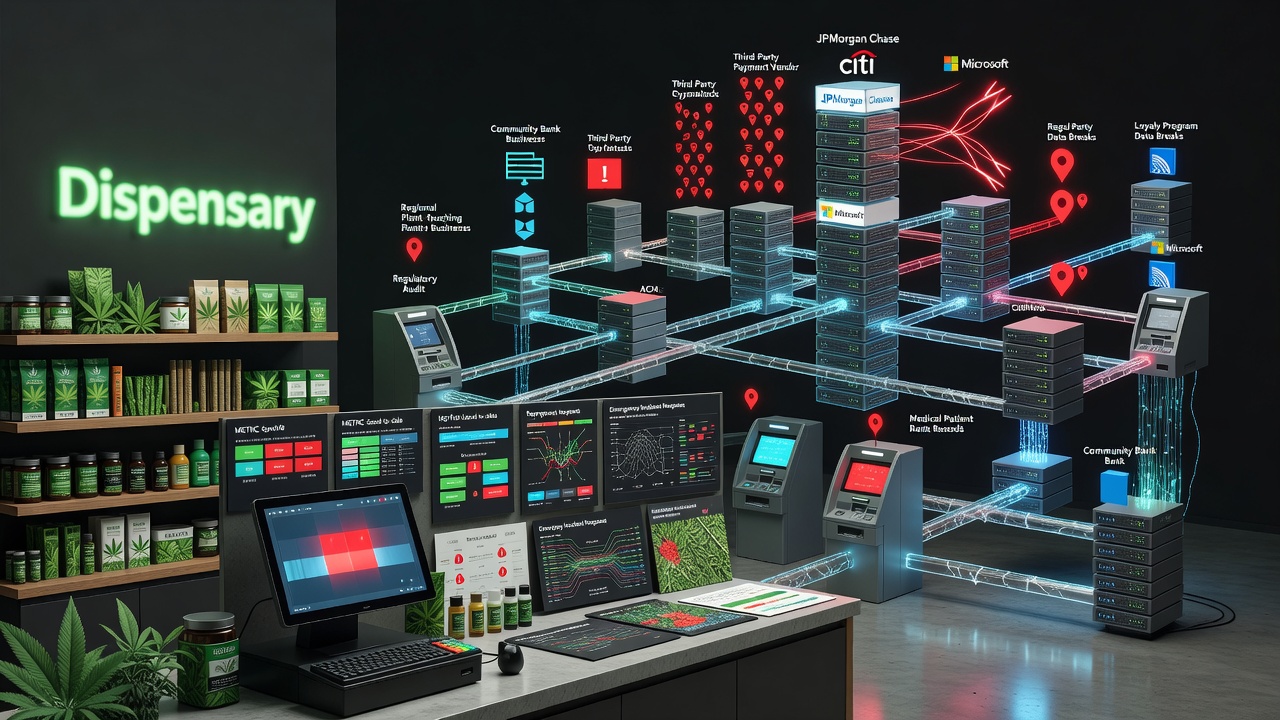
The wave of technology outages hitting Microsoft, JPMorgan Chase, United Airlines and other major institutions over the past week carries a lesson that cannabis retailers and their financial partners cannot afford to ignore: the plumbing behind cashless payments, seed-to-sale tracking, and compliance reporting runs through the same banking and cloud infrastructure now showing cracks. For an industry already locked out of most traditional banking relationships, that dependency cuts both ways.
Why Dispensary Operators Should Care About Bank Infrastructure
Most dispensaries don't bank directly with JPMorgan or Citi. But the handful of regional and community banks willing to serve cannabis-related businesses often rely on the same correspondent banking networks, payment processors, and compliance software vendors that larger institutions use. When a major bank patches a vulnerability and something breaks - as cybersecurity experts now say is increasingly likely - the disruption can ripple down to the smaller institutions that process dispensary deposits, cashless ATM transactions, and ACH transfers for wholesale purchases. A frozen payment rail doesn't care whether the merchant is a national retailer or a single-location dispensary trying to make payroll.
That's the catch with the current moment: artificial intelligence tools are helping banks find vulnerabilities faster than ever, but fixing those vulnerabilities means constant patching, and constant patching means more opportunities for outages. For a cannabis retailer whose banking relationship already sits on thin ice, an unexpected disruption at a payment processor or banking partner isn't just an inconvenience. It can mean a point-of-sale terminal going dark mid-shift, a delayed vendor payment that trips a compliance deadline, or a cashless payment network freezing transactions at the worst possible time - budroom traffic on a Friday afternoon.
Third-Party Risk Looks Different in a Plant-Touching Business
Banking and cybersecurity experts speaking this week emphasized that institutions need to know exactly which vendors are critical to their operations and how resilient those vendors are. Cannabis operators face a sharper version of that same problem. Many dispensaries depend on a narrow set of specialized vendors - cashless payment processors built specifically to work around federal banking restrictions, seed-to-sale platforms that interface with state traceability systems like METRC, and point-of-sale providers that layer compliance logic on top of standard retail software. There is rarely a deep bench of alternatives to switch to if one of those vendors suffers an outage or a breach.
That concentration risk deserves the same business continuity thinking banks are now being pushed to adopt. Operators should ask: if our payment processor goes down for a day, what's the manual workaround, and is it compliant? If our compliance software can't sync with the state traceability system, does that create a reporting gap that regulators could flag during an audit? These aren't hypothetical questions anymore. They're the kind of table-top exercise banks are now running internally, and dispensary operators would do well to run a version of their own.
Compliance Logs and Data Exposure
JPMorgan's disclosure that third-party vendors were targeted in a cyberattack exposing customer marketing data is a reminder that cannabis retailers sit on sensitive information too - purchase histories, medical patient records in states that still maintain medical programs, loyalty program data, and the compliance logs required under state law. A breach at a point-of-sale vendor or a marketing platform used by a multi-state operator could expose exactly the kind of personal data that regulators and consumers now expect businesses to protect, cannabis or otherwise.
In practice, though, the fix isn't complicated: ask vendors directly about patching cadence, incident response plans, and whether their systems have been stress-tested against the kind of AI-driven exploitation now described as common rather than rare. A vendor that can't answer those questions plainly is a vendor worth reconsidering, regardless of how good the wholesale menu integration looks on paper.