
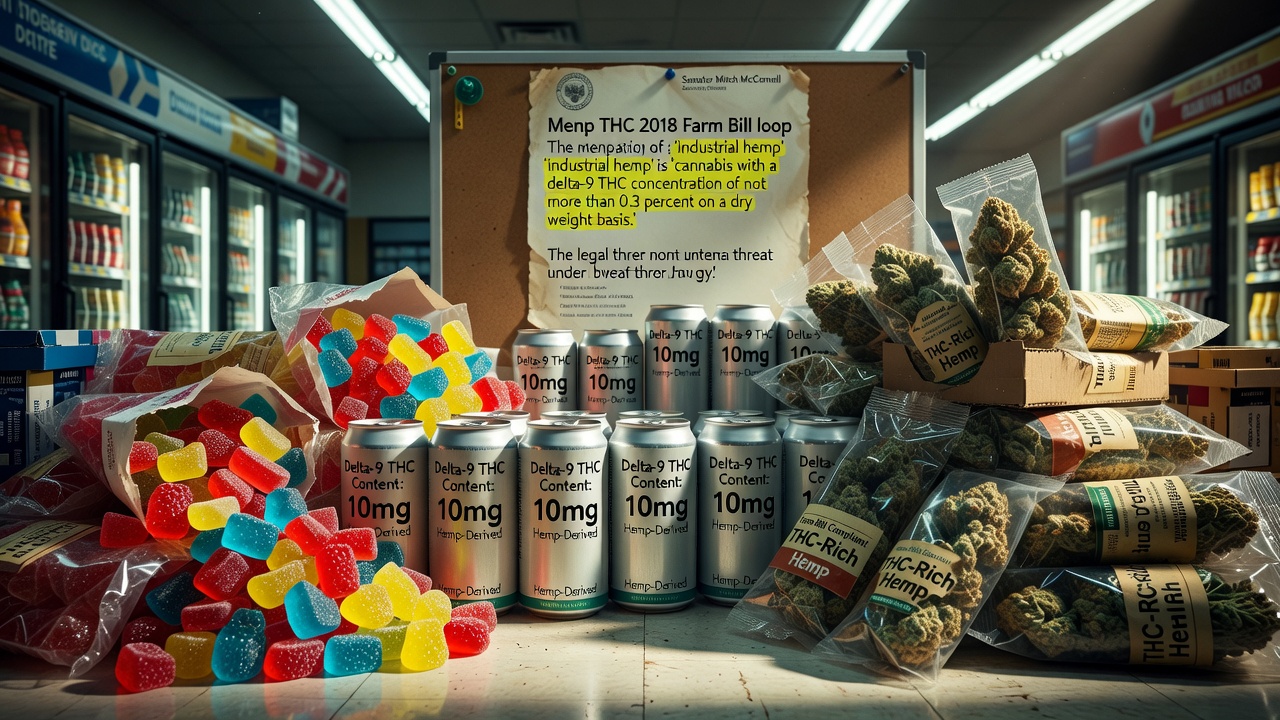
A federal ban on intoxicating hemp products now takes effect Dec. 11, not Nov. 12 as originally scheduled, after Congress tucked a short delay into last month's government-funding bill. That gives an industry built on hemp-derived gummies, seltzers and smokable flower roughly one more month to convince lawmakers to regulate the products instead of eliminating them outright. The reprieve is narrow, and nobody in the business is treating it as a reprieve at all so much as a deadline.
A Loophole Born in the 2018 Farm Bill
Here's the mechanism that created this market in the first place. Senator Mitch McConnell's 2018 farm bill legalized industrial hemp by defining it as cannabis containing less than 0.3 percent delta-9 THC by dry weight. That threshold was meant for fiber and grain crops, not consumer edibles. But a gummy or a can of seltzer can hit that delta-9 ceiling on a weight basis while still packing enough total THC, often through other cannabinoids or concentrated extraction, to produce real intoxication. Manufacturers built entire product lines around that math. Some went further, selling raw flower under the argument that its THC exists as THC-A and only converts to impairing delta-9 when heated, a workaround that let smokable hemp flower move through gas stations and smoke shops as though it were an ordinary wellness product.
The result was a parallel market operating outside state-licensed cannabis programs, with none of the seed-to-sale tracking, COA requirements, or age-gating that regulated dispensaries live under. Products ended up on convenience store shelves and, in some cases, in mainstream retail, available to anyone regardless of age, with no mandatory lab testing and no consistent packaging standards.
Why Licensed Operators Have a Stake Here
Dispensary owners in adult-use and medical markets have watched this unfold with something closer to resentment than curiosity. Licensed cannabis retailers absorb excise tax, 280E's punishing federal tax treatment, strict compliant packaging rules, and testing costs that run through every product batch. Hemp THC sellers largely did not. That cost gap let unregulated hemp products undercut wholesale pricing in states where marijuana remains illegal and compete on shelf space even where it doesn't. For multi-state operators who've spent years building compliance infrastructure, a hemp ban without replacement regulation might remove a competitor, but a hemp ban with no enforcement teeth would just push the same unregulated flow further underground.
States didn't wait for Washington. Dozens have already moved to regulate or outright ban intoxicating hemp products, creating a patchwork that operators and distributors now have to track state by state, not unlike early-stage marijuana legalization itself. That inconsistency is part of why industry advocates are pushing Congress toward a federal regulatory framework rather than a blunt prohibition: a ban with no distribution channel for existing inventory, no transition period for manufacturers, and no clear line between hemp wellness products and intoxicating ones creates chaos for compliance teams on both sides of the hemp-marijuana divide.
What Happens if Dec. 11 Arrives Without a Fix
For operators like those running commercial kitchens producing THC gummies, the calculus is stark. Inventory on hand, supplier contracts, lease obligations on production facilities, none of that disappears just because a federal statute does. Businesses built over several years could lose their product line overnight, with no transition window to liquidate stock or pivot formulations below the delta-9 threshold.
The policy question in front of Congress isn't really whether hemp-derived intoxicants should exist unregulated. Most people across the cannabis and hemp industries agree they shouldn't. The question is whether Congress replaces the loophole with actual rules, testing standards, age restrictions, potency caps, before the ban takes hold, or whether it simply lets the market vanish and assumes the risk goes with it. Given that the delay only survived as a rider on a funding bill, a permanent legislative fix by Dec. 11 is not something anyone in this industry is counting on.