
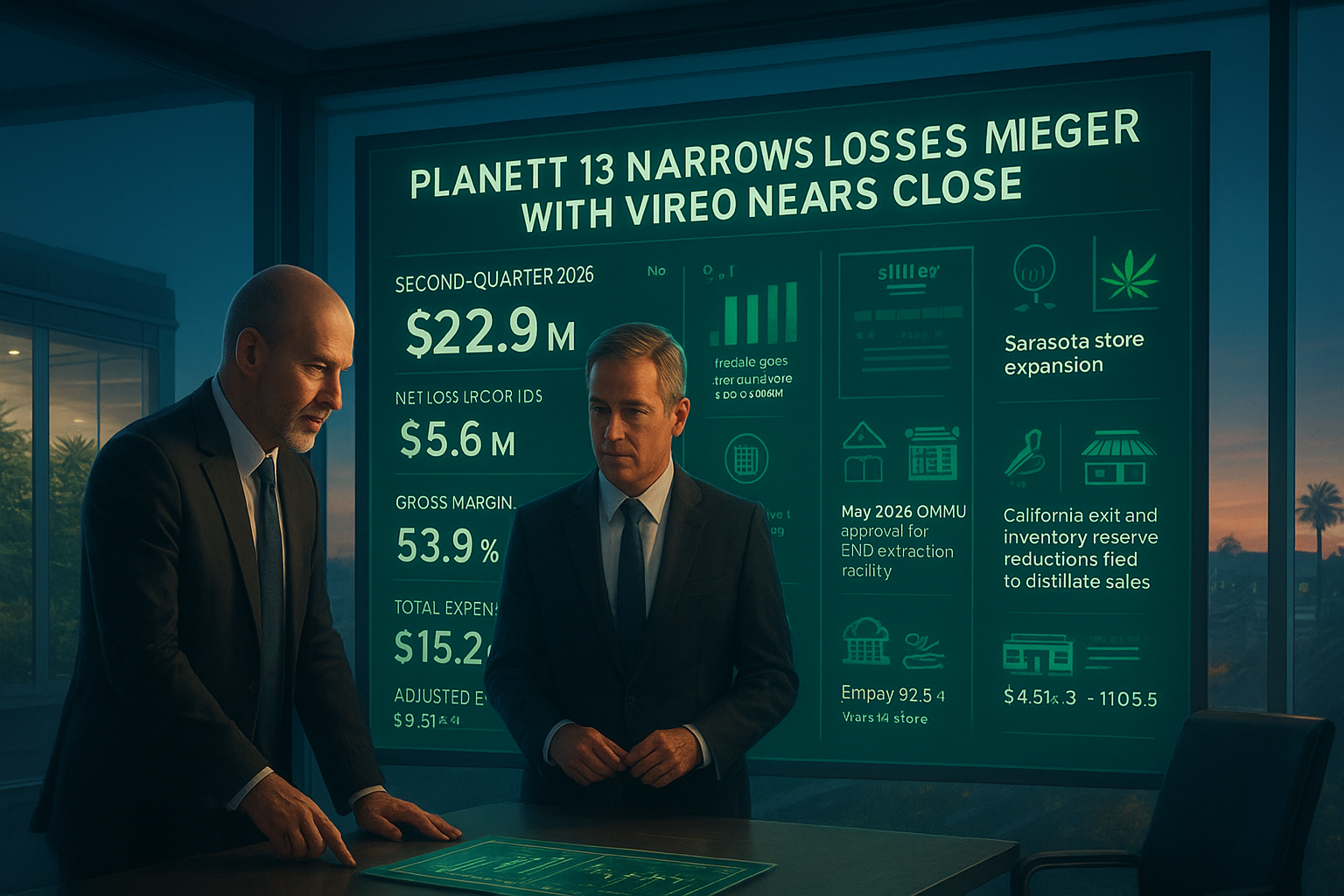
Planet 13 Holdings reported second-quarter 2026 revenue of $22.9 million, down 14.9% from a year earlier, as the multi-state operator worked through a California exit and continued price compression in Nevada and Florida. Net loss narrowed sharply to $5.6 million from $13.3 million, and gross margin climbed to 53.9% from 43.4%, evidence that cost discipline is catching up with a tougher wholesale pricing environment. The quarter also arrives against the backdrop of a pending merger with Vireo Growth Inc., a deal that reframes nearly every operational decision the company makes right now.
Margin Gains Tell a More Complicated Story Than Revenue Decline
A 14.9% revenue drop sounds like retrenchment. In practice, though, the numbers underneath it point to something closer to a cleanup operation. Planet 13 walked away from California retail and wholesale entirely, a market long known among operators for brutal wholesale pricing and compliance costs that rarely pencil out for smaller vertically-integrated players. Exiting removed a drag on the P&L, and it shows: gross profit rose to $12.3 million even as top-line sales fell. Total expenses dropped 17.7% to $15.2 million, reflecting company-wide cost-cutting rather than a single one-time adjustment. Strip out a $1.0 million inventory reserve reduction tied to Florida distillate, and adjusted gross margin still lands at 49.5% - a meaningful improvement that suggests procurement initiatives and SKU rationalization are doing real work, not just flattering a single quarter's results.
Florida's Sequential Growth Signals a Market Finding Its Footing
Florida revenue increased 17.1% quarter over quarter, a data point Co-CEO Larry Scheffler called out directly. That's notable because Florida's medical cannabis market has been a mixed bag for multi-state operators managing distillate inventory, extraction capacity, and shifting patient demand simultaneously. Planet 13's May 2026 OMMU approval for a BHO extraction facility in Florida, paired with the announced Sarasota store expansion in July, points to a company still building out infrastructure in the state even as it retreats elsewhere. The inventory reserve reduction for Florida distillate - a direct result of increased sales absorbing excess product on hand - is the kind of granular operational detail that matters more to supply chain managers than headline revenue figures. Excess distillate inventory ties up working capital and invites write-downs; working it down is a quiet but real signal of improving unit economics.
Adjusted EBITDA Improvement Reflects Structural, Not Just Seasonal, Change
Adjusted EBITDA loss narrowed to $0.5 million from $2.4 million a year earlier. For a sector where 280E tax treatment already squeezes net margins regardless of federal legal status, that kind of improvement in a shrinking-revenue environment is the more instructive metric. It tells operators and investors that the cost base itself changed, not merely that a soft quarter got less soft. Total assets declined modestly to $144.3 million from $152.3 million at year-end 2025, while total liabilities ticked up to $105.5 million, a balance sheet picture consistent with a company managing through transition rather than expanding aggressively.
The Merger Overshadows the Quarter, and That's the Point
Planet 13 skipped its usual earnings conference call this quarter, citing the pending merger with Vireo Growth. Co-CEO Bob Groesbeck framed the deal plainly: the cannabis retail market increasingly rewards scale, purchasing power, distribution breadth, and balance sheet strength to absorb continuing price compression. That's a fair read of where multi-state cannabis competition has landed. Smaller vertically-integrated operators face a persistent squeeze between compliance costs, wholesale price erosion, and the inability to access traditional banking and lending on the same terms as other retail sectors. A combination with a larger platform doesn't eliminate those structural pressures, but it can spread them across more stores, more markets, and a bigger purchasing footprint. For now, Planet 13's operational story is one of disciplined retrenchment - exit underperforming markets, tighten procurement, stabilize Florida - while the corporate story moves toward a different company altogether.