
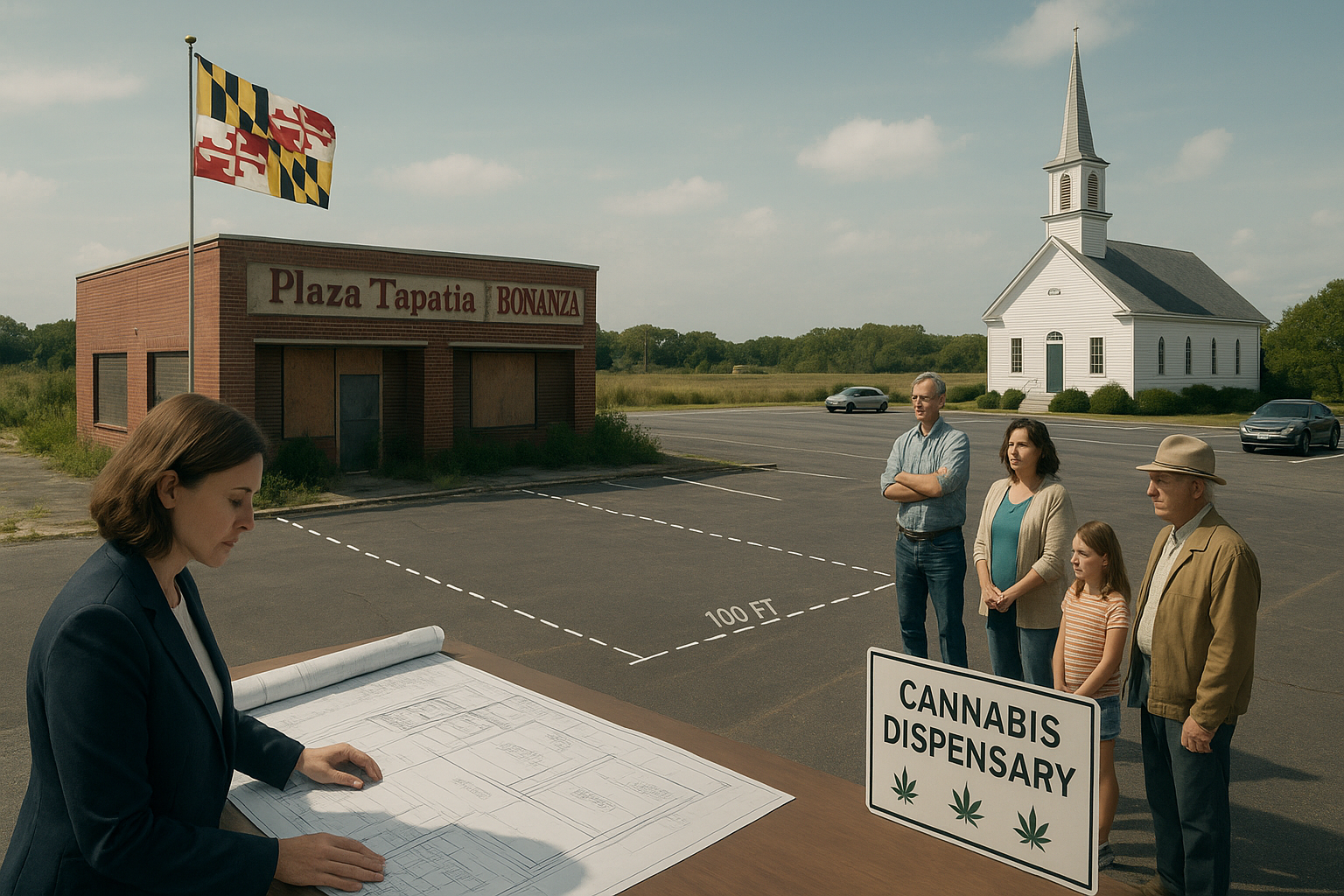
A proposed cannabis dispensary in Pocomoke City, Maryland has cleared one of its earliest regulatory obstacles - a separation distance requirement tied to a nearby church - but city officials are clear that the project is nowhere near open for business. The Board of Zoning Appeals recently signed off on the property-line-to-property-line measurement from the proposed site, a former Plaza Tapatia and Bonanza Steakhouse building on Ocean Highway, to the church parcel. Site plans still need to be submitted, reviewed, and approved, and a building permit must follow before any construction or buildout work can begin.
For cannabis operators and real estate professionals watching how municipalities handle adult-use retail siting, the Pocomoke case offers a useful illustration of how layered local review can be - even in states where cannabis is legal and the use is permitted by right under state law. That last phrase matters. Maryland's adult-use framework generally preempts localities from outright banning dispensaries in areas where zoning otherwise allows retail, but it does not strip cities of the right to enforce separation requirements, site plan standards, or building codes. In other regulated cannabis markets, similar friction points have pushed operators to invest early in experienced land-use counsel and compliant facility planning. Those working with a Missouri dispensary POS platform or any multi-state retail technology stack already know that local permitting timelines rarely align with software rollout schedules, making pre-opening compliance planning a genuine operational discipline, not an afterthought.
What's striking here is the specificity of what the board actually decided - and what it did not. Pocomoke City Planning Director Kristen Tremblay was direct on this point: the Board of Zoning Appeals measured the distance from property corner to property corner, not structure to structure. That distinction matters in practice. A corner-to-corner measurement is typically more restrictive than a building-face or structure-to-structure measurement, since it captures the full footprint of each parcel rather than the placement of buildings on those parcels. For operators conducting early-stage site selection, that methodology can determine whether a potential location clears the threshold or falls short - often by a matter of feet.
Community Reaction and the Small-Market Reality
Pocomoke City is a small, family-oriented community on Maryland's Eastern Shore, and the proposal has drawn skepticism from at least some long-term residents. One local said she was surprised by the zoning board's decision and would have preferred to see the former restaurant property return to food service use. The building has been vacant for years. That sentiment - a preference for economic activity perceived as more broadly accessible - is a recurring theme in small-market cannabis retail debates across the country. Dispensaries generate tax revenue and employment, but their appeal to the broader commercial district depends heavily on foot traffic patterns, consumer demographics, and whether the operator invests in a retail experience that draws repeat visits rather than one-off transactions.
The fair point here is that a dispensary in a low-density market faces real operational pressure on unit economics. Wholesale pricing, staffing ratios, and compliance costs - including inventory tracking, compliant packaging, and state reporting requirements - do not scale down proportionally with population size. A dispensary in a market like Pocomoke City may carry similar overhead to a larger urban store while serving a fraction of the customer volume. That math puts pressure on margins from day one.
License Caps and What They Mean for the Local Market
Tremblay noted that only three dispensary licenses are currently permitted in Worcester County, and she is not aware of additional licenses being added to the county's allocation in the near term. That cap is not incidental - it is one of the structural features of Maryland's adult-use licensing framework, which tied license counts in part to population and geographic distribution to prevent market saturation. For the applicant in Pocomoke City, the limited county-wide license count actually works in their favor; it reduces competitive pressure within the immediate trade area. But it also means that any delay in completing site plans, clearing city review, or securing a building permit extends the pre-revenue period with no guarantee that the license remains viable if the project stalls.
Tremblay said the zoning board's decision does not open the door to a wave of similar applications. If another proposal does come forward, the city would apply the same property-corner-to-property-corner methodology. That consistency is worth noting - it suggests the city has a defined procedural posture rather than an ad hoc one, which is generally better for operators trying to assess permitting risk before committing capital to a site.
What Comes Next for the Applicant
The immediate task is straightforward on paper. The applicant must submit a complete site plan that conforms to city code. Once Tremblay determines the submission is complete, the project can be placed on a Planning Commission agenda. From there, additional review, potential conditions, and a building permit stand between the current moment and any physical work on the space.
That process is not unusual for regulated retail. Dispensary buildouts routinely involve specialized requirements around security systems, vault or safe room specifications, ventilation, signage restrictions, and ADA compliance - all of which must be reflected in the site plan. Getting those details right the first time shortens the review cycle. Getting them wrong can push a project back by months. For the Pocomoke City applicant, the zoning distance ruling is a genuine step forward. But the gap between a cleared separation-distance requirement and a ribbon-cut opening is wide, and every remaining step requires both regulatory precision and deliberate project management.