
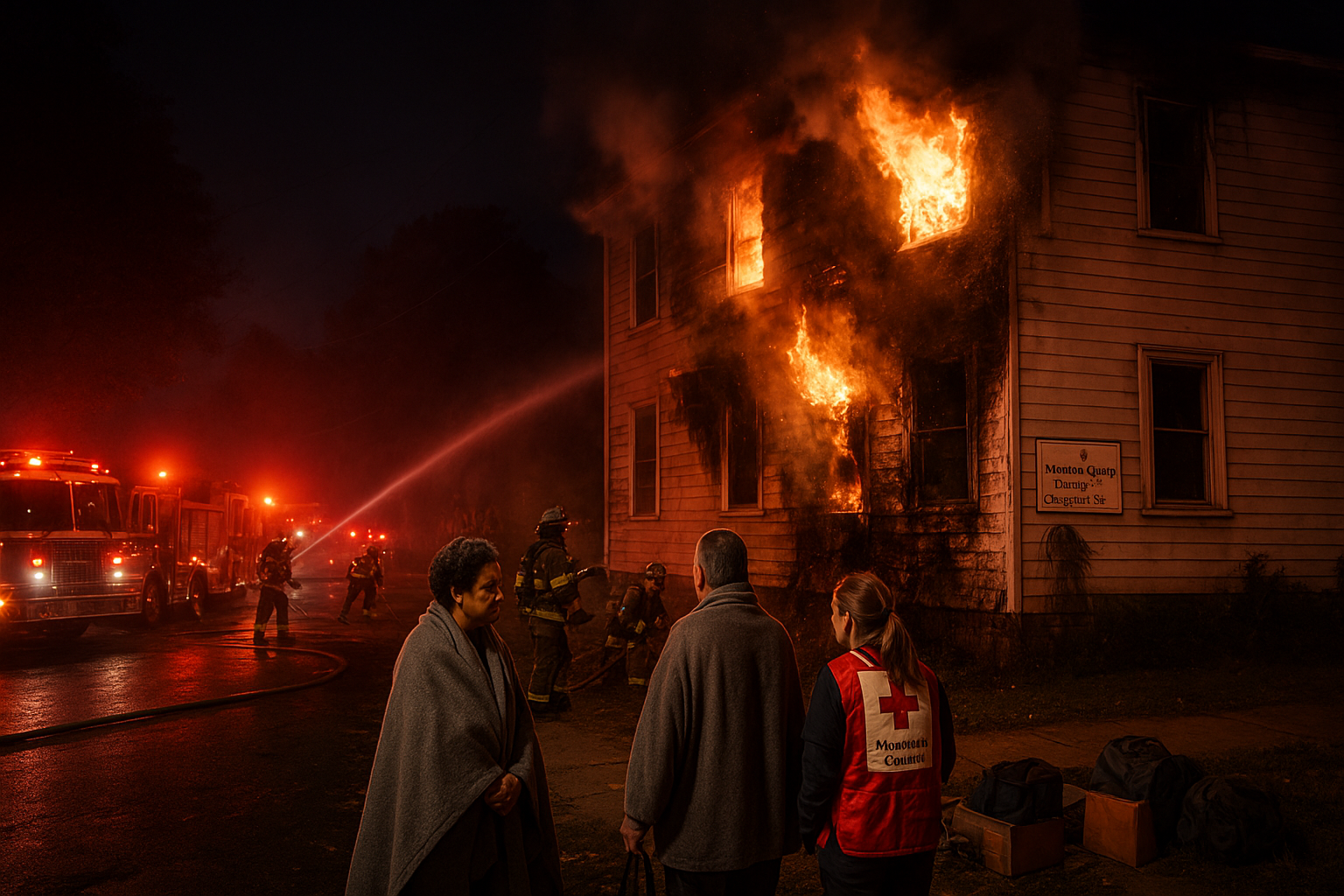
A pre-dawn fire tore through a duplex at 141-143 Chestnut Street in Red Bank, New Jersey early Thursday morning, displacing two families and drawing mutual aid from five neighboring fire departments. Red Bank Fire Chief Michael Welsh said the blaze appears to have started on the exterior of the structure, with investigative focus falling on external air conditioning units. One firefighter was treated at the scene for exhaustion; no other injuries were reported.
Firefighters received the call at 2:33 a.m. and were joined by departments from Middletown, River Plaza, Sea Bright, Little Silver, and Fair Haven. The scale of the mutual aid response reflects the intensity of the incident - and the operational complexity of managing a multi-unit residential structure fire in the early hours. For property owners and operators of multi-tenant buildings, the incident is a reminder of how exterior mechanical equipment, often overlooked in routine maintenance cycles, can present serious risk. That conversation is active in commercial real estate broadly; even in adjacent licensed-retail sectors such as dispensary real estate and cannabis retail build-outs, where operators managing mixed-use or older structures have increasingly turned to technology platforms - from cannabis pos maryland systems to building management integrations - to keep better operational logs on facility conditions and maintenance schedules. The principle holds across property types: deferred maintenance on exterior equipment carries real liability.
Monmouth County property records list the duplex owner as Meir Kasnett, with an address in Lakewood; the property was purchased in 2021. The cause of the fire remains under active investigation by both the Monmouth County and Red Bank fire marshals. The American Red Cross is providing assistance to the two displaced families.
Exterior Equipment and Fire Risk in Multi-Unit Properties
External air conditioning units as a suspected ignition point is not an unusual finding for investigators. Compressor failures, electrical faults, accumulated debris around condenser units, and improper installation clearances have all been documented contributors to exterior structure fires. The risk compounds in multi-unit residential buildings where shared mechanical infrastructure - often aging - may serve multiple households but fall under a single owner's maintenance responsibility.
For landlords and property managers, the practical implication is straightforward: routine inspection schedules for exterior HVAC equipment are not optional paperwork. They are a risk-management baseline. Insurance underwriters increasingly treat documented maintenance records as a material factor in both coverage terms and claims resolution. A fire that starts outside the building doesn't stay there.
Community Response and Displaced Residents
The Red Cross response activated quickly - which is typically how these situations unfold when local fire command coordinates displacement support. For two families, the immediate aftermath of a 2:33 a.m. fire means emergency shelter, loss of personal property, and an uncertain timeline before any return to a livable space, if one is even possible. That human reality sits behind every fire investigation report.
The investigation remains open. Until the fire marshals conclude their work, the exact cause - and the chain of responsibility - won't be formally established. What's already clear: exterior mechanical systems failed in a way that cost two families their homes, at least for now.