
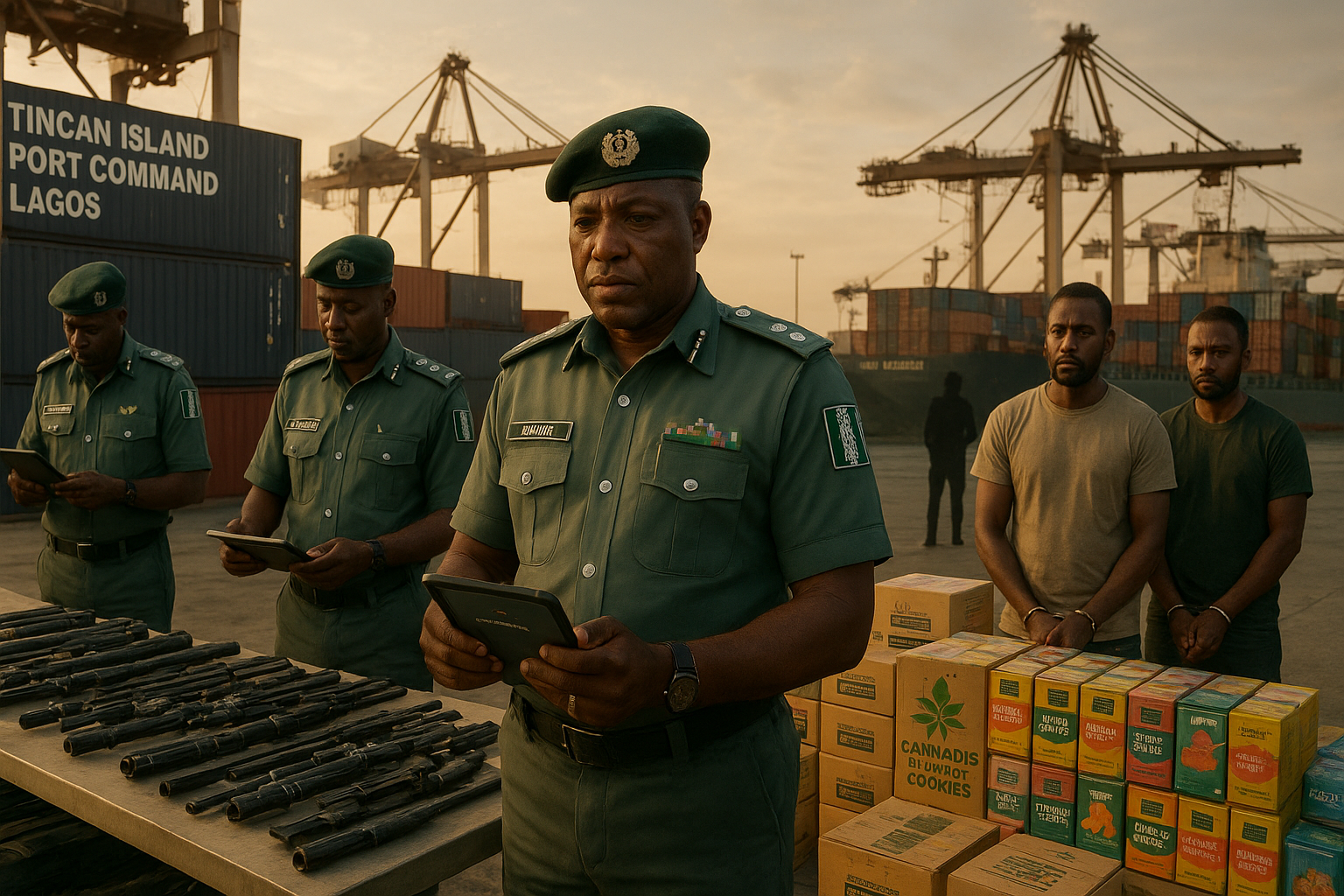
Nigerian border enforcement just delivered a reminder of how porous global trade routes remain for both weapons and unregulated cannabis products. The Nigeria Customs Service (NCS) announced on 6 August 2026 that officers at the Tincan Island Port Command had intercepted a container hiding parts for more than 140 pump-action rifles, alongside a separate seizure of cannabis-infused goods valued above ₦373.8 million. Both operations, disclosed by Comptroller General Adewale Adeniyi, point to a supply chain problem that extends well beyond Nigeria's borders - one that touches manufacturers, freight forwarders, and any retailer operating in the gray zones between legal and illegal cannabis trade.
The firearm parts arrived aboard MV VELIKA on 8 July 2026 and were flagged by the Service's intelligence-driven risk management system before physical inspection even began. That detail matters for anyone tracking how customs enforcement is evolving worldwide: risk profiling, manifest analysis, and predictive flagging are becoming standard tools, not optional extras. It's the same logic that underpins compliant retail operations elsewhere in the legal cannabis sector - where operators rely on systems like marijuana pos software to track inventory, flag irregularities, and maintain the kind of audit trail regulators now expect as a baseline, not a bonus. Two suspects tied to the rifle parts have been arrested; a third remains at large. marijuana pos software
Cannabis Products Concealed Among Legitimate Cargo
The second seizure is arguably more instructive for anyone in the legal cannabis trade watching how illicit product moves. Customs officers intercepted two 40-foot containers carrying Delta-8 cannabis-infused pre-roll cookies, gummies, and cookie products - concealed among used vehicles, generators, and batteries. The breakdown: 109 cartons of Delta-8 pre-roll cookies, 125 cartons of Delta-8 gummies, and 73 cartons of cannabis-infused cookies, combining for a street value north of ₦373.8 million. That's not a small operation. Concealing product inside unrelated cargo - vehicles, machinery, batteries - is a smuggling technique that works precisely because it exploits the volume and complexity of legitimate import channels.
For licensed operators in regulated markets, this is the flip side of everything compliance teams work to prevent domestically: unlabeled product, no lab testing, no COA, no age-gating, no traceability. Products moving through legal seed-to-sale systems carry batch records, potency disclosures, and packaging that meets local child-resistant and labeling standards. Smuggled cannabis-infused goods carry none of that. Consumers who encounter such products, wherever they surface, have no verified information about potency, contaminants, or manufacturing conditions - a real consumer-safety gap that regulators in every jurisdiction cite as justification for strict licensing and testing regimes.
Election-Season Enforcement and Internal Controls
Adeniyi's warning about the coming election cycle is worth sitting with. He said criminal networks tend to test border defenses harder during politically sensitive periods, and pledged tighter scrutiny at ports and airports. He also addressed a less comfortable reality directly: internal compromise. "The Nigeria Customs Service will not harbour any of these people who want to serve as accomplices," he said, acknowledging that smuggling networks sometimes rely on insider cooperation rather than pure evasion. That's a candid admission, and it lines up with what compliance officers in regulated industries everywhere already know - perimeter controls only work if the people staffing them aren't compromised too.
What This Means for Legitimate Supply Chains
Container-level smuggling of both weapons and cannabis products puts pressure on every legitimate importer and freight partner operating through the same ports. Enhanced screening, longer clearance times, and stricter manifest verification tend to follow high-profile seizures like this one - a cost that ripples down to wholesalers and retailers waiting on inventory. For operators in markets where cannabis is legally regulated, the episode is a useful contrast: it shows what happens in the absence of licensing, lab testing, and traceable distribution. Compliance isn't paperwork for its own sake. It's the mechanism that keeps a legal product legal, traceable, and safe enough for adult consumers to trust.