
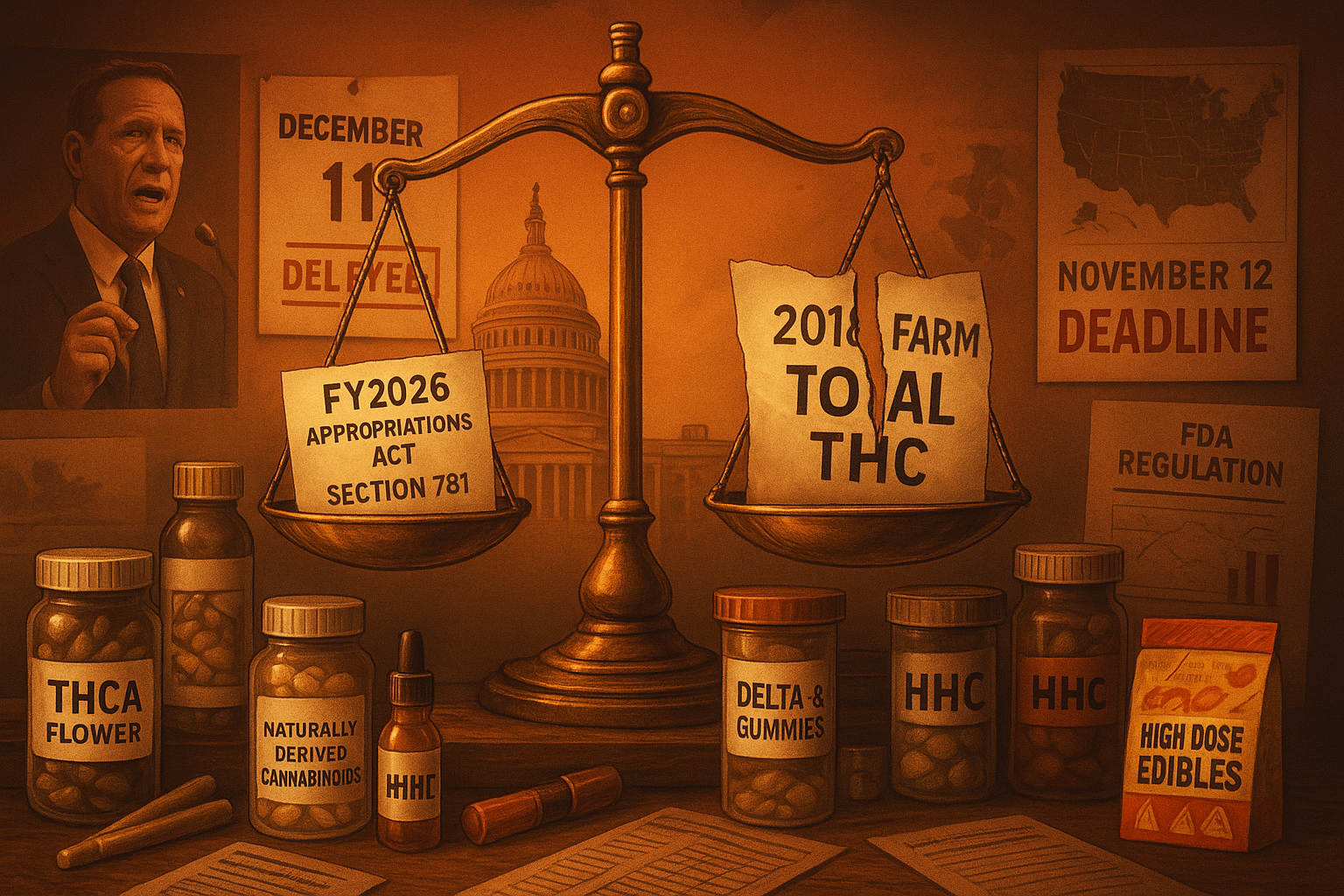
Retailers waiting for clarity on the federal hemp ban got a partial answer this month, and it's not the one either side wanted. A law redefining hemp under a total-THC standard is already signed and on the books. What's still unresolved is exactly when it bites, and that ambiguity is now a Senate-versus-House problem rather than a settled compliance date.
Here's the mechanism operators actually need to track. Section 781 of the FY2026 appropriations act swaps the old delta-9-only threshold for a total-THC calculation that folds in THCA, plus a 0.4mg total-THC cap per retail container on finished goods. That single definitional shift is what turns THCA flower, high-dose gummies, and converted cannabinoids like delta-8 into federally noncompliant SKUs once the clock runs out. For multi-state operators, the practical work right now is layering that federal floor against whatever your state already requires - and the mix varies more than most buyers realize, which is part of why understanding new york cannabis laws alongside federal timing matters if you're sourcing or shipping hemp-derived inventory across state lines.
The Senate's August 8 vote pushed most of the restrictions from November 12 to December 11, 2026 - but only for naturally derived cannabinoids. Synthetics didn't get the reprieve. That's not a minor footnote for compliance teams; it means delta-8, delta-10, and HHC formulations face the earlier date regardless of how the House handles the stopgap bill. Budroom inventory built around converted cannabinoids is on a different countdown than THCA flower sitting three shelves over.
Why the Definition Change Matters More Than the Date
The 2018 Farm Bill measured one thing: delta-9 THC by dry weight. That narrow yardstick is what let THCA flower, delta-8 vapes, and beverage-dosed edibles operate legally as "hemp" even though plenty of them intoxicate just like traditional cannabis products. Critics call this the farm bill loophole, and it's the reason regulators pushing the new law frame it as consumer protection rather than prohibition. Supporters point to pediatric emergency room data and gas-station packaging that mimics candy as the justification. The hemp industry counters that it asked for FDA oversight, age-gating, and consistent lab testing years ago and got ignored instead.
Both arguments hold up. That's the uncomfortable part for anyone trying to write clean compliance policy. A THCA pre-roll testing above 20% THCA was never going to survive a total-THC recalculation - the math simply doesn't work under the new formula. Delta-9 beverages and gummies at typical dosing blow past 0.4mg per container without much room to reformulate down to that level and stay commercially viable. Delta-8 and HHC products fail for a completely different reason: they're excluded outright as synthesized cannabinoids, independent of potency.
What Operators Should Actually Be Doing Right Now
Treat the enacted law as fixed and the date as fluid. That's the operational posture that makes sense given where things stand. The Senate-passed delay still needs House approval and a signature before December 11 becomes real, and Senator Ted Budd's push to strip that delay - tabled 61-32 - shows there's organized appetite to keep the original November 12 date alive when the funding conversation resumes.
- Audit wholesale menus and POS SKUs for products relying on THCA potency, converted cannabinoids, or delta-9 dosing near or above 0.4mg per container.
- Separate synthetic-cannabinoid inventory from naturally derived stock in compliance tracking, since they're now on different federal timelines.
- Confirm your state's testing and licensing framework independently of federal status - permissive state law doesn't override the coming federal floor.
- Watch for FDA cannabinoid clarification lists, which were directed by the law but haven't been published.
For dispensary operators, wholesalers, and brands sitting on hemp-derived inventory, the honest read is this: nothing forces a shelf-clearing decision today, but nothing about the current trajectory suggests the market keeps operating exactly as it does now. Plan for December 11 as a working date, not a guarantee, and build sourcing decisions around state rules that apply regardless of how Congress settles the federal question.