
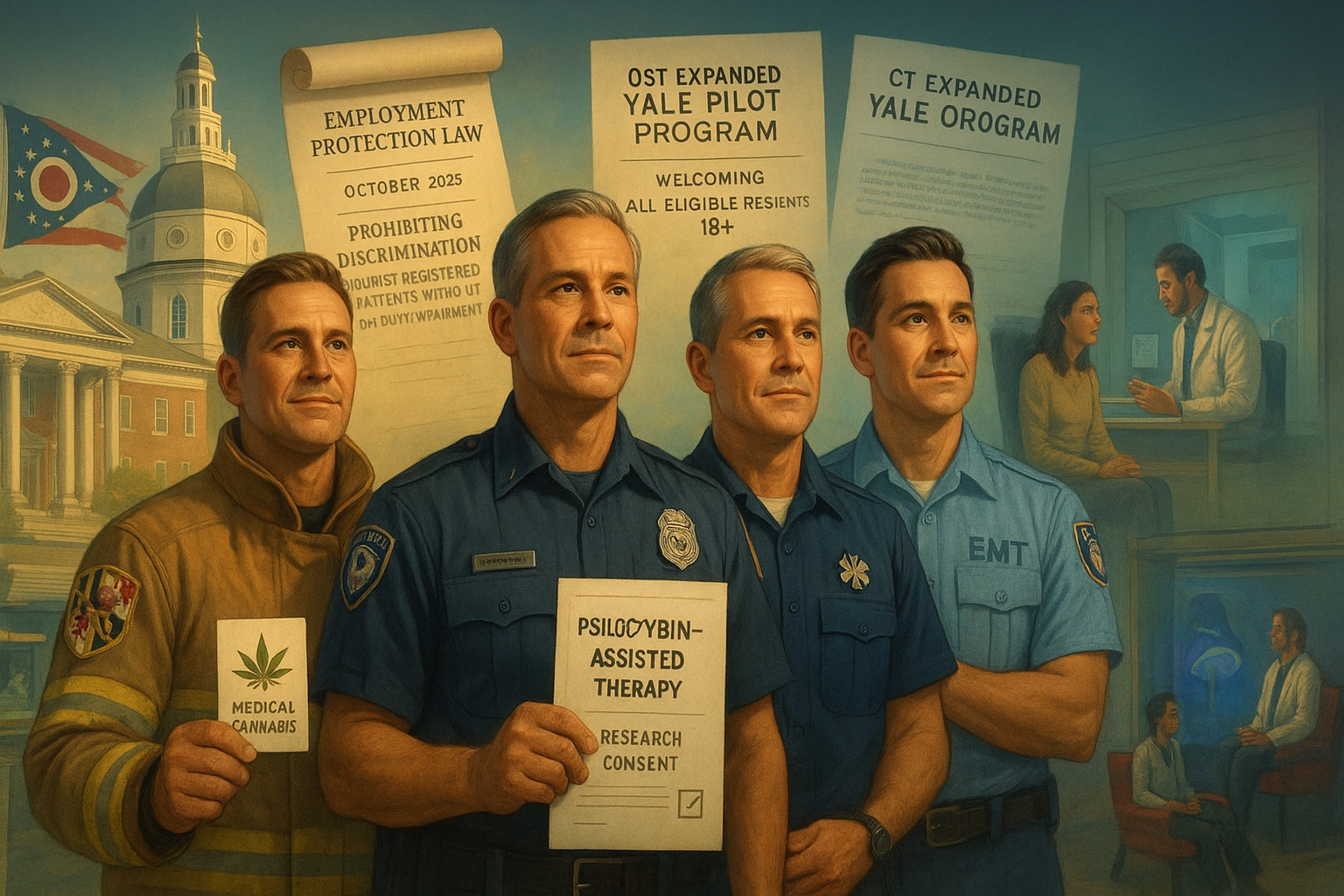
A wave of state-level legislation in 2025 is reshaping how first responders - firefighters, police officers, paramedics, EMTs - can access treatment for post-traumatic stress, and cannabis dispensary operators and compliance teams should be paying close attention. Several states have enacted or advanced laws this year that either extend medical cannabis employment protections or open the door to supervised psychedelic therapy programs. The direction of travel is clear: the patchwork is getting more complicated, not less.
Maryland's approach is the most immediately relevant for licensed cannabis operators. A new law - effective October of this year - prohibits employment discrimination against registered medical cannabis patients who are firefighters, EMTs, paramedics, or other rescue workers, provided those workers are not impaired while on duty. The distinction the law draws matters: a positive test for cannabis metabolites, absent on-duty impairment, cannot be used as grounds for adverse employment action. For dispensaries serving medical patients in first-responder roles, that's a meaningful shift in how workplace drug policy intersects with patient access. To understand how medical cannabis market rules vary by state and affect dispensary compliance posture, see how it works in a regulated state context. The Maryland law doesn't change what dispensaries are required to do operationally, but it signals that state-level patient protections are expanding - which affects the population of patients who can now participate in medical programs without risking their careers.
Ohio moved in a different direction. Republican Gov. Mike DeWine signed legislation creating a Post-Traumatic Stress Injury Commission, which will review applications from eligible first responders and provide assistance with treatment costs. That framework is traditional - structured, state-administered, and built around existing therapeutic approaches. It doesn't touch cannabis or psychedelics directly. But the underlying pressure it responds to is the same: traditional counseling and medication alone aren't meeting the demand, and states are looking for frameworks that can. As Jason Cerrano, a retired firefighter and paramedic with more than 20 years of experience in Missouri, put it: "When you are in the fire service, or any first responder industry, or especially in the military, stuff builds up over time, and what happens is you see so many things that the crazy stuff starts to at least seem normal." Cerrano now serves as director of commercial research and development at IDEX Fire & Safety.
Psychedelic Research Enters the Policy Mainstream
Connecticut and Missouri represent something newer and harder to categorize. Connecticut expanded a Yale University pilot program studying psilocybin-assisted therapy, opening participation to any state resident 18 or older who meets the clinical eligibility criteria set by Yale's institutional review board. Previously, the program was limited to veterans, retired first responders, and frontline health care workers. That's a notable expansion - and it suggests psilocybin research is moving from a narrow carve-out into something closer to a general clinical trial framework.
Missouri lawmakers went further in scope, if not in outcome. The legislature advanced a bill that would have allowed veterans and first responders in approved research studies to receive psilocybin and ibogaine under medical supervision for PTSD and other mental health conditions. The legislature adjourned in May before the bill reached the governor's desk. In practice, though, the fact that it advanced at all - in a state with a Republican-controlled legislature - signals how much the political calculus around psychedelic-assisted therapy has shifted, particularly when framed around first responders and veterans.
What This Means for Cannabis Operators and Compliance Teams
Here's the catch for dispensary operators watching these developments: they don't create new revenue pathways directly, but they do reshape compliance exposure in states with active medical cannabis programs. Employment protection laws for medical patients affect who presents at your dispensary, what documentation they carry, and - critically - whether your staff understand that a patient's protected status has legal weight behind it. That's a budtender training issue. It's also a POS-level documentation issue in states where patient verification is tied to seed-to-sale tracking and METRC compliance logs.
The psychedelic research thread is a different matter. Psilocybin and ibogaine remain federally scheduled substances. None of the state measures described here create commercial markets - they're research frameworks, not licensing regimes. Multi-state operators watching the psychedelics conversation should treat it as a regulatory horizon issue, not an immediate operational one. The comparison to early medical cannabis pilot programs is not a perfect analogy, but it's a useful lens: research-stage authorization often precedes commercial licensing by years, and the compliance infrastructure doesn't build itself.
What's striking here is the convergence. States are arriving at similar problems - undertreated PTSD in high-trauma professions - through very different legal mechanisms. Maryland reached for patient employment protection within its existing medical cannabis framework. Ohio reached for a state commission and treatment cost assistance. Connecticut and Missouri reached for psychedelic research expansion. None of these paths lead to the same place. But all of them reflect the same underlying policy judgment: the current standard of care isn't sufficient, and the law needs to make room for alternatives. For licensed cannabis businesses operating in the medical space, that's both a market signal and a compliance reminder - patient protections are getting stronger, and the regulatory environment around them is still being written.