
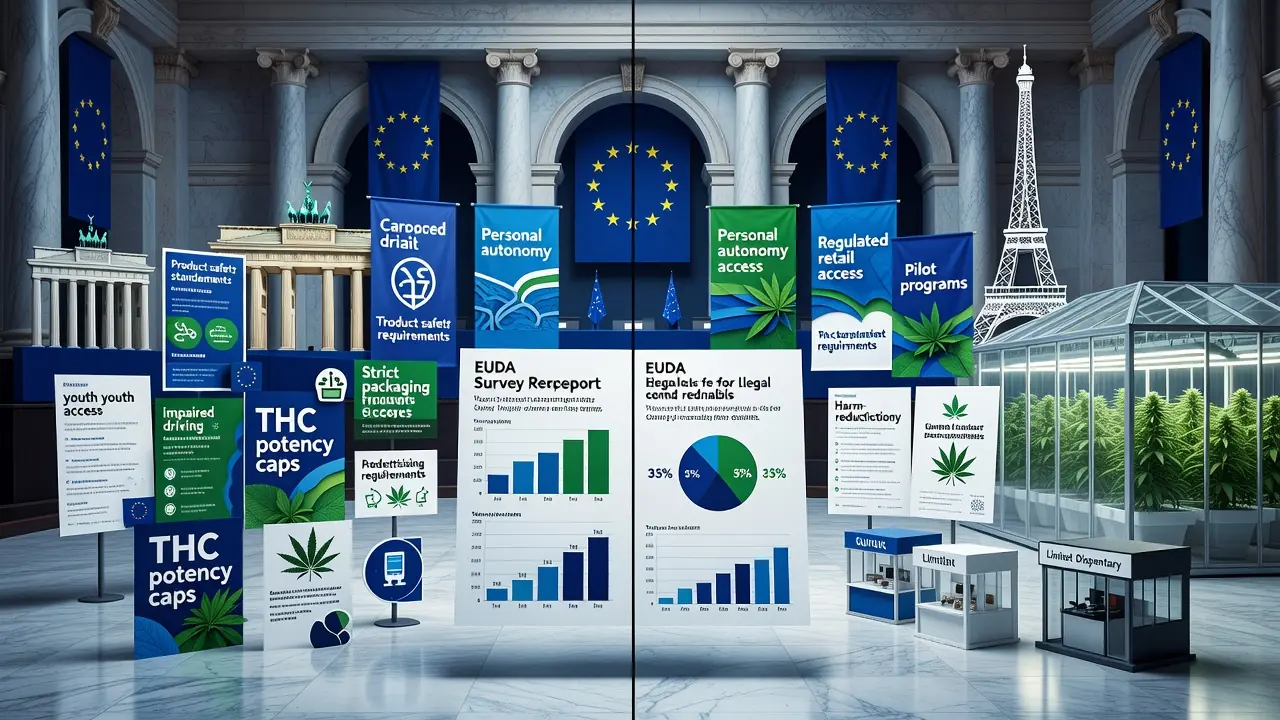
A new survey from the European Union Drugs Agency (EUDA) looks at how residents across member states perceive cannabis availability and the policies that govern it. The findings land at a moment when several European countries are actively reworking their approach to cannabis - from pilot retail programs to decriminalization debates - making public sentiment a factor regulators and operators alike are watching closely.
Why Public Perception Shapes Policy Timelines
Regulators rarely move on cannabis policy in a vacuum. Public opinion data, however imperfect, tends to feed directly into how fast - or how cautiously - lawmakers are willing to expand access. In jurisdictions considering adult-use frameworks or expanded medical programs, survey results showing public unease about availability can slow legislative timelines, while findings that show broad comfort with regulated access can accelerate them. The EUDA survey fits into that pattern: it's not regulation itself, but it's the kind of data point that ends up cited in parliamentary debates and ministry briefings.
That matters for operators building businesses on the assumption that market access will open or expand on a predictable schedule. A license applicant betting on a 2026 adult-use rollout in a given country needs to understand that perception surveys like this one can shift political appetite in either direction, sometimes faster than formal rulemaking does.
What the Divide Over Access Actually Signals
Surveys of this kind typically capture a split between people who favor tighter control - citing youth access, impaired driving, or product safety - and those who favor broader legal availability, often on harm-reduction or personal-autonomy grounds. The split itself is not new. What's worth watching is how that divide maps onto specific policy levers: retail density, advertising restrictions, THC potency caps, and packaging requirements. Each of those levers is a compliance line item for any operator trying to build a cannabis business inside a regulated European market.
In practice, though, public ambivalence tends to produce incremental policy rather than sweeping legalization or sweeping bans. That's consistent with what's already happening across the EU, where most movement has come through narrow medical frameworks, limited pilot programs, or decriminalization of possession rather than full commercial retail buildout.
Operational Stakes for Businesses Watching Europe
For multi-state operators and investors eyeing European expansion, perception data is a leading indicator worth tracking alongside actual legislative text. A country where survey respondents express strong support for medical access but deep skepticism about recreational retail is likely to keep its commercial channel narrow - meaning limited dispensary-style outlets, strict advertising rules, and conservative licensing caps even if medical cannabis continues to normalize.
- Advertising and marketing restrictions tend to tighten, not loosen, when public comfort with retail access is mixed.
- Age-verification and packaging standards remain a near-universal baseline regardless of where public opinion lands.
- Pilot programs - such as coffee shop supply trials already running in parts of Europe - serve as real-world test cases regulators cite when public sentiment is divided.
None of this guarantees a particular outcome. But for compliance teams and market-entry planners, the survey is a reminder that cannabis policy in Europe is still being negotiated in public, not just in committee rooms - and that the pace of commercial opportunity will keep tracking closer to caution than to speed.