
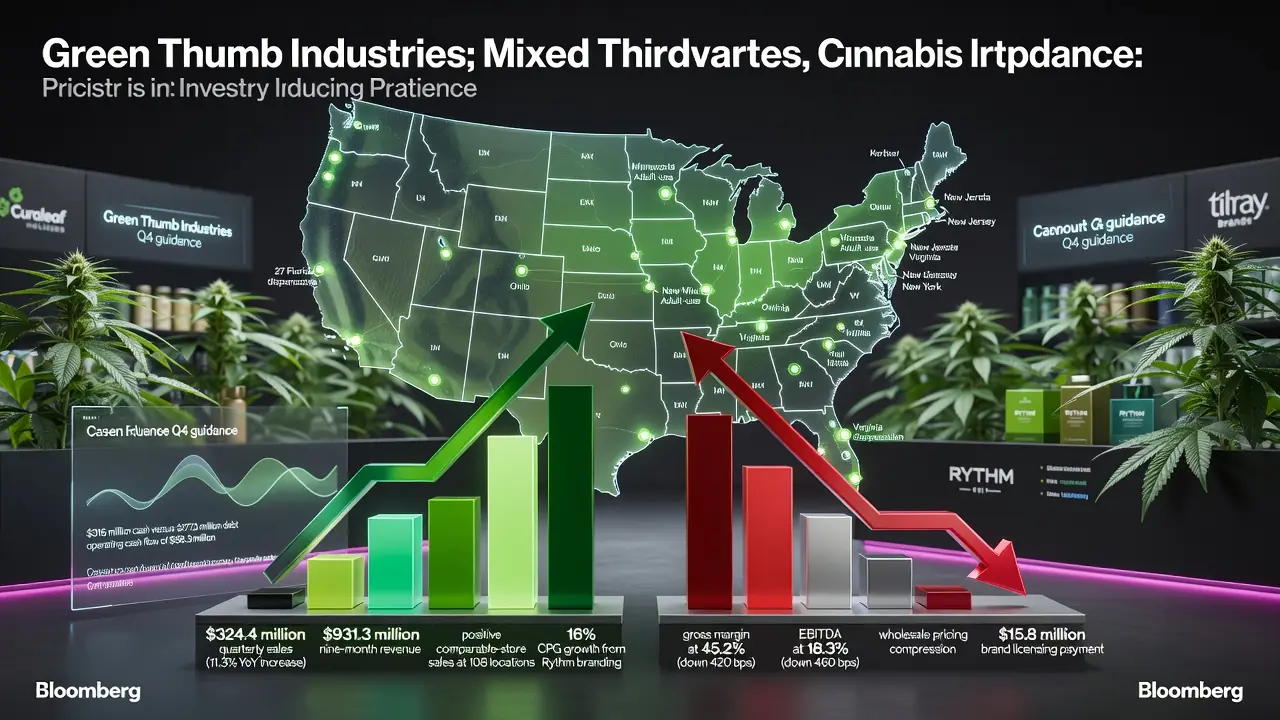
Green Thumb Industries posted third-quarter revenue that beat expectations, but the bottom line told a different story: a 2-cent-per-share loss against a 10-cent profit a year earlier. Sales climbed 11.3% year over year to $324.4 million. That gap between top-line growth and bottom-line erosion is the real story here, and it's one that touches nearly every multi-state operator wrestling with wholesale pricing compression right now.
Revenue Growth Meets Margin Reality
Nine-month revenue rose roughly 8% to $931.3 million, helped along by Minnesota's adult-use launch and steady contributions from Florida, New Jersey, New York, Ohio and Virginia. Retail revenue grew 10%, and comparable-store sales across 108 locations turned positive for the first time since the third quarter of 2024 - a notable inflection after a quarter of roughly 1% declines. Consumer packaged goods revenue jumped 16%, driven largely by Minnesota's early momentum.
Here's the catch: gross margin fell 420 basis points to 45.2%, and EBITDA margin dropped 460 basis points to 18.3%, partly due to a $15.8 million brand licensing payment to Rythm. In practice, though, the underlying pressure isn't a one-time accounting item. Price compression across mature markets continues to squeeze margins even as unit volumes hold up, a pattern familiar to any operator who has watched wholesale menus flatten while retail competition intensifies. Minnesota, still a young market, is already seeing new dispensary entrants chip away at early-mover advantage - a reminder that adult-use launches rarely stay lucrative for long once licensing expands.
Expansion Continues, But Timing Varies by State
Green Thumb added three Florida locations after quarter-end, bringing its footprint there to 27 stores and more than 130 nationally. Virginia represents a longer-term bet: adult-use sales aren't set to begin until July 2027, and management expects supply constraints in the market's early years - a common bottleneck when cultivation licensing lags retail rollout. The company's Texas entry remains conditional on regulatory developments, underscoring how much multi-state operator growth still depends on state-by-state licensing timelines rather than company execution alone.
Management's own guidance for the fourth quarter is cautious: flat to slightly lower sequential revenue, with further price compression expected even as some markets stabilize. Complicating comparisons further, Green Thumb began consolidating Rythm, Inc. into its financials effective October 10, 2026, meaning Q4 results won't line up cleanly against prior periods. For investors trying to read trend lines, that's a genuine analytical headache.
Capital Returns and the Uplisting Question
Green Thumb has repurchased about 29.5 million shares for more than $200 million since late 2023, including over $80 million this year, with the board adding $50 million in authorization through September 2027. The company holds $316 million in cash against $277.3 million in debt, with $58.3 million in quarterly operating cash flow - a balance sheet that gives it room to keep investing while buying back stock.
A U.S. exchange uplisting remains a possibility, but CEO Ben Kovler has downplayed it as an immediate catalyst, noting that federal scheduling and tax clarity would matter more to valuation than listing venue alone. That's a fair point. Until 280E tax treatment changes meaningfully, cannabis operators remain boxed in by a cost structure that ordinary retailers don't face, no matter where their stock trades.
Where That Leaves the Stock
Against competitors like Curaleaf Holdings, with its broad retail and international footprint, and Tilray Brands, which diversifies beyond cannabis into beverages and wellness, Green Thumb remains more tightly tied to U.S. cannabis market conditions. That concentration cuts both ways: it means direct exposure to Virginia's and Florida's growth, but also full exposure to pricing pressure with no offsetting business lines. Analyst estimate revisions have been mixed, with 2026 figures trending lower and 2027 only edging up slightly. Given persistent margin pressure and limited visibility into when pricing stabilizes, a wait-and-see posture looks reasonable until clearer signs of margin recovery emerge.