
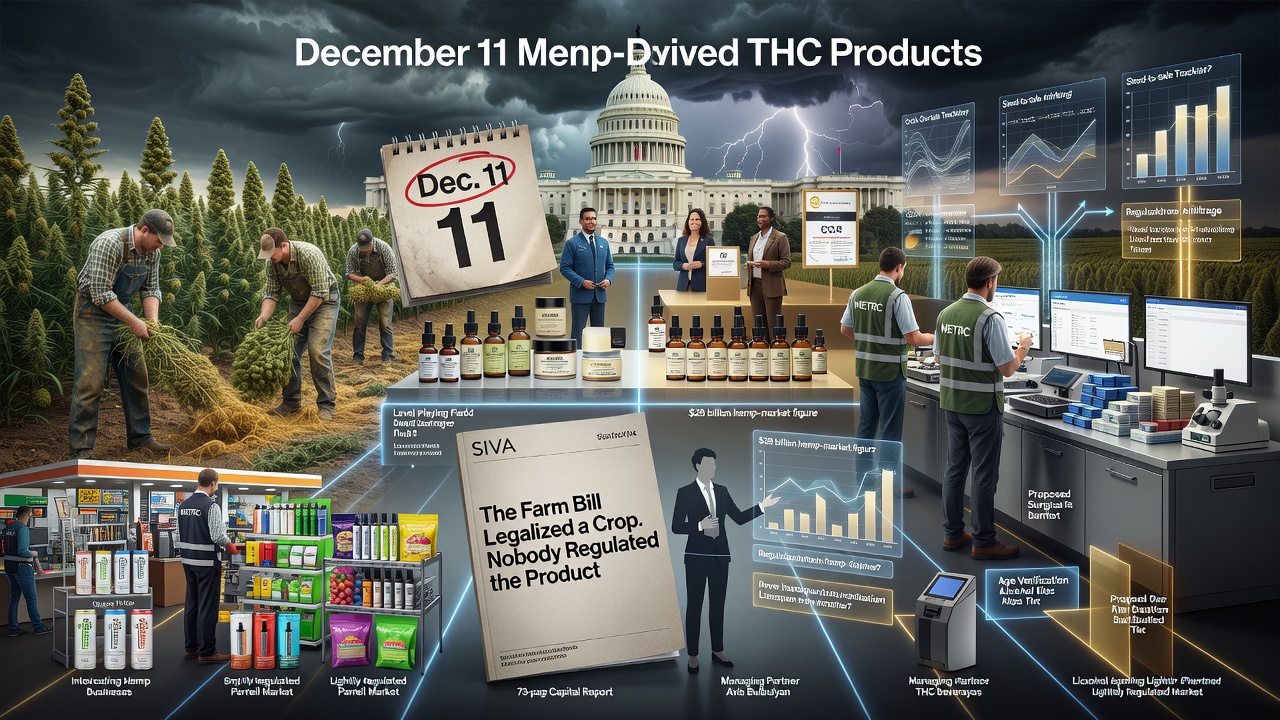
Congress has a date circled on the calendar: Dec. 11, the point at which a farm bill provision tied to hemp-derived intoxicants is set to close. What happens before then could determine whether thousands of businesses selling hemp-derived THC products keep operating, and whether state-licensed cannabis operators face a durable competitor built on a different set of rules. A new 73-page report from SIVA Capital argues that Washington has been debating this as if "hemp" were a single interest group, when it is actually several, pulling in different directions.
One Crop, Several Constituencies
The report, titled "The Farm Bill Legalized a Crop. Nobody Regulated the Product," breaks the hemp debate into distinct camps: farmers growing the raw crop, CBD manufacturers selling nonintoxicating wellness products, patients who rely on those products, state-licensed cannabis operators working under seed-to-sale tracking and strict compliance regimes, state regulators tasked with enforcement, and a newer category - intoxicating hemp businesses selling THC beverages, gummies and vapes largely outside that compliance framework. Treating these groups as one bloc, the report contends, obscures what each actually stands to gain or lose depending on how Congress acts.
That matters because the legislative fixes on the table - another delay, an outright ban, or doing nothing - carry very different consequences depending on which constituency you're asking. A farmer growing fiber or grain hemp has little in common, commercially, with a company selling a 5mg THC seltzer at a gas station. Yet both get lumped into the same floor speeches.
The Parallel Market Problem
Here's the part that should concern anyone operating a licensed dispensary or holding a cannabis manufacturing license: if Congress simply preserves the current hemp loophole, it effectively codifies a second, lightly regulated THC market running alongside the state-licensed one. Licensed operators absorb excise tax, mandatory lab testing, compliant packaging rules, age-verification requirements and METRC reporting. Many hemp-derived intoxicant sellers don't carry the same overhead - no cultivation license, no state excise tax, often no COA requirement with teeth behind it.
That's not a level playing field. It's wholesale pricing distortion by regulatory arbitrage, and it puts pressure on every link in the licensed supply chain - growers, processors, retailers, even the POS and compliance software vendors built around state track-and-trace systems. Avis Bulbulyan, SIVA Capital's managing partner and a former member of California's Cannabis Advisory Committee, put it plainly: "Congress is being asked to preserve a market without a clear accounting of what that market is, who actually depends on it or what preserving it would cost the rest of the industry."
Questioning the Numbers Driving the Debate
The report also takes aim at the economic claims circulating in Washington, including a widely cited $28 billion hemp-market figure that, per the report, rests on modeled demand projections rather than verified sales data. Employment counts, tax-revenue estimates and predicted business closures tied to a loophole closure deserve the same scrutiny. In a policy fight this consequential, modeled numbers presented as hard figures can shape legislation in ways that are difficult to undo once the vote is cast.
A Narrower Fix Than Congress Is Considering
Rather than another extension or a blanket ban, the report proposes something more surgical: let the December loophole closure take effect, restore sensible rules for legitimate nonintoxicating CBD products, and build a narrow, state-controlled pathway for THC beverages modeled on existing adult beverage distribution and licensing infrastructure.
- Nonintoxicating CBD products would get regulatory clarity instead of getting caught in a crackdown aimed at intoxicants
- THC beverages would move toward state oversight resembling alcohol distribution - age verification, licensed distribution tiers, testing requirements
- State-licensed cannabis operators would avoid competing against a shadow market with lower compliance costs
"This isn't about choosing between hemp and cannabis," Bulbulyan said. "It's about whether Congress fixes an unintended consequence of the farm bill or builds an entirely new regulatory system around it. Those are very different decisions, with consequences that extend well beyond December."
For dispensary owners, multi-state operators and the compliance teams keeping their licenses intact, the outcome of this debate isn't academic. It determines whether the market they operate in has one set of rules or two.